

Almost Timely News: 🗞️ How AI Detection Works (2026-06-07)
There are no surprises with AI

Almost Timely News: 🗞️ How AI Detection Works (2026-06-07) :: View in Browser
The Big Plug
👉 My new course, GEO 201 on competitive GEO measurement, is now for sale.
Content Authenticity Statement
99% of this week’s newsletter content was generated by me, the human. You will see a small piece by Google Gemini in the opening section. Learn why this kind of disclosure is a good idea and might be required for anyone doing business in any capacity with the EU in the near future.
Watch This Newsletter On YouTube 📺
Click here for the video 📺 version of this newsletter on YouTube »
Click here for an MP3 audio 🎧 only version »
What’s On My Mind: How AI Detection Works
This week, let’s talk AI detection and how it works. My buddy Becca pinged me earlier this week with this request:
“I need your wizard secrets on AI detectors 😭 no matter how I write I get flagged! Even voice to text! HOW DO YOU DO IT?! Your posts are perfect and so well written which usually means AI would flag them but they don’t?“
After a lengthy exchange, I asked whether she’d had Claude Code try to solve the problem, and Claude told her no, it wouldn’t help her reverse engineer an AI detector.
And it was at this point where I cracked my knuckles, looked askance at the false god, and said to the Twisting Nether, “BET.”
Here’s the story of how I reverse engeineered an AI detector and what I found.
Part 1: Writing is Code
If you recall from a couple months ago, I wrote about some of the ways we can measure writing. Writing is code, at its heart. It’s not purely creative, because there are clear rules to writing. As I say in my keynotes, I can speak the words “I’m spilling the tea” and you know what they mean, even if you don’t understand the slang.
On the other hand, if I say, “Tea the spilling I’m”, you might be forgiven for thinking my cat walked on the autocorrect. Why? Because language has clear structure and rules. In North American English, that usually means (and yes, there are tons of exceptions, the English language is practically made of exceptions) subject-verb-object as a word order. In fact, there’s like a dozen or so languages on planet Earth (out of 1,377) that are object-verb-subject like Aiwoo and Urarina. The majority of languages are subject-object-verb (”I’m the tea spilling”).
So language has rules, order, and predictability. It’s code. In fact, code is writing and writing is code. When you ask someone who’s working in Python or Rust what they’re doing, more often than not they’ll say they’re writing code. Not making code, not generating code, not typing code, but writing it.
In turn, that means it can be measured and quantified. There’s an entire field about this, natural language processing (NLP), which predates generative AI by decades. Folks who have been in the AI space since the Obama years likely remember all the ups and downs of NLP during that time, from IBM Watson winning Jeopardy to the AI winter of the mid 2010s.
Part 2: What You Can Quantify
Before we can get to reverse engineering an AI detector, we have to start with reverse engineering writing. What are the different measures of writing we can objectively analyze? As I mentioned just above, NLP has been at this practice for decades. There are over 60 different measures of writing and ways to measure writing mechanistically, deterministically. (Aka there’s a concrete number at the end of the analysis)
Let’s take a look at just a handful; I’m working on a course for Trust Insights that will go into these in much greater depth, but this is a start.
Sentence length. How long are your sentences? Sometimes we write super long sentences - I do this a ton when I’m thinking out loud or when I’m dictating; those issues of this newsletter that have super long run-on sentences are a dead giveaway that I dictated the sentence rather than typed it.
Sentence length variation. Imagine you analyzed a blog post you write and you tabulated all the sentence lengths. For some of my content, my sentence length variation looks like this: 14-12-4-17-8-14. Sometimes I write super short sentences, sometimes I write very long ones.
Sentence length patterns. Those short and long sentence patterns are not random. If you read my writing, a very short sentence is usually followed by a very long one.
Why? If you look at how I write, especially in places like LinkedIn, I’m very fond of the short/long pattern. I’ll write something like this:
(Expository paragraph)
(Short emphasis)
(Long explanation)
That’s just my personal style. Other people write what folks have amusingly titled “broetry” (mostly dudes, hence the name) who write as though it was literally transcribed from William Shatner’s Captain Kirk:
You know…
…what…
…I mean!
Here’s the thing about sentence patterns - our writing style is predicated in part on how we use sentences, along with how we use line breaks, punctuations, em dashes, the works. For example, I never, ever use the em dash and I never have. Why? Not because I care about AI, but because I learned to type on a manual typewriter. An em dash is two keystrokes. An en dash is one. Instead of em dashes, I write with a space/en dash/space pattern. Again, that’s a personal style thing.
But the key takeaway here is that our writing style, as individuals, is a combination of very distinct patterns.
Part 3: How AI Detectors Work
Now, let’s talk about AI writing. All generative AI, all AI period, is probability. All of it. All AI models are probability engines and they produce their predictions as the next word, the next sentence, the next thing in order. Unguided, they produce the highest likely probability for an item in a sequence.
Let’s watch this example of KoboldCPP, which is a language model server serving up the Skyfall model, and watch it generate words. You’ll see the text on the left, and you will see the actual server making predictions on the right.
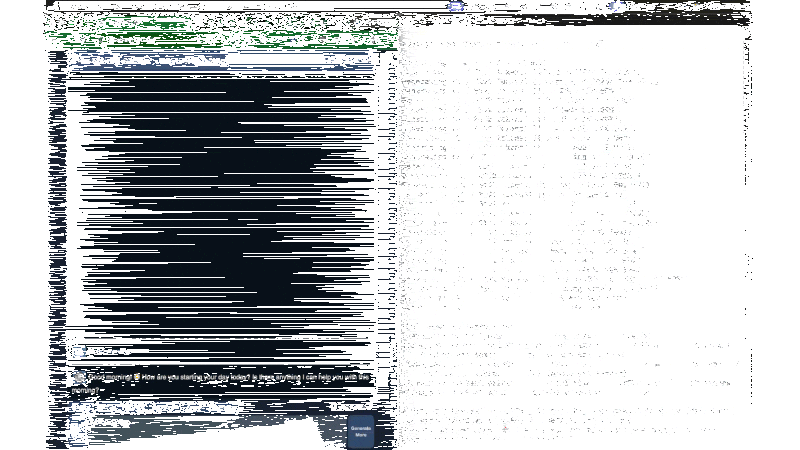
Look carefully where at token 10 it was saying how are you and then its choices were starting or doing. How are you doing or how are you starting? It had to make a decision at that point in the flow as to whether one word is a better fit than the other. And it chose starting at 50.97% probability versus doing at 49.03% probability.
Because of their very nature, AI outputs have much more uniformity than human outputs when it comes to… well, anything. That’s their nature, and that nature is what not only makes them useful, but also what gives away that something is AI generated.
You know AI generated content. You can feel this, when you read a post or look at an image or a video. It’s not that it’s too perfect - it’s very often not. It’s not that it’s glaringly wrong either, not with skilled use. (Yes, there’s a lot of unskilled use out there that’s dead easy to spot)
It’s that when you use AI, it creates patterns that are much more averaged out and homogenous. For example, going back to sentence length from the previous section, I write like this: 14-12-4-17-8-14
What does AI write like? Probably more like this: 14-12-13-15-14-13-14.
And you can feel that, even if you can’t put it in words. There’s a certain roundness to it that’s obvious once you know to look for it. There’s a cadence that AI keeps which is intrinsic to it, and those patterns are what AI detectors often look for. All AI models have writing styles, and like people have writing styles, there is something of an AI writing style.
The same is true for AI image generation, video generation, music generation - it all comes out sort of average, because that’s literally how it works under the hood. It’s coming up with the highest probabilities for a given context.
Very often, we want high probability outputs. If you’re doing protein folding, trying to predict the next mutation of a virus, you absolutely want high probability. If you’re doing forecasting, trying to determine when the holiday shopping season will start, you absolutely want high probability. If you’re doing law and you are writing legal documents that have to fit a certain standard, you want the highest probability because you don’t want original writing in a legal contract. You want writing that stands up to a proven standard, that has stood the test of time in courts.
We constantly want to know what’s going to happen next. Weather forecasting has existed since humans first started farming, and that’s probability assessment that predates language itself.
Let’s talk specifically about writing. Here’s the thing about creative work: great creative work in general is low probability. As I say in one of my keynotes, if you write “he had gastric distress”, that’s a high probability, informative, but not particularly creative way to describe a situation. If you write “it looks like he powerwashed his toilet with Nutella”, that’s is a very low probability phrase. You’re not going to find that in medical reports, in most of the training data that AI has learned from.
When people complain about AI outputs in the creative space, it’s because fundamentally, there are no surprises in AI generated content. There’s no wacky turn of phrase, no unexpected small details, no signatures of a single mind.
The lack of surprising patterns - and there are dozens of them - are what AI detectors have been built to recognize. That’s how they work. They’re built to examine things like sentence length patterns, like word distribution and diction, and dozens of other combinations to look for common fingerprints. Depending on which company you talk to, they may also use LLMs - language models - in their detectors as well (which is a whole different problem). These tools use AI to essentially measure how surprising the next word in a sequence is.
When AI writes and it doesn’t produce surprises, these tools flag that and say this is probably AI generated because of the lack of surprises.
The Problem With AI Detectors
Here’s the fundamental problem with AI detectors: they’re very, very fallible. Why? Because lack of creativity in writing isn’t just a machine thing - it’s a very, very human thing. Crappy writers generate copy that looks an awful lot like machine-generated copy. Mediocre photographers take images that look just like AI generated images. Songwriters who lack skill make templated songs that sound like every other song in their genre and sound like AI made them - because it’s all probability.
This is especially problematic in things like education and academia because education is SO templated that the outputs will inherently resemble AI. Take, for example, the academic standard five paragraph essay. There are literal templates that students are handed:
First paragraph is your introduction where you state your premise
Last paragraph is your conclusion where you recap your premise
Three paragraphs in the middle where you explain your premise
Recommended/required transition words to move from paragraph to paragraph
Recommended sentence lengths, third person voice, neutral point of view
Guess what this looks like? Yep. AI. Even the best human writers, when forced into a rigid template like this, are going to create slop - human slop, but slop nonetheless. High probability, low creativity slop. Not a single surprise in the text.
And then when a school district or a teacher uses an AI detector and it sees the exact same patterns that AI generates, they hand out punishments for a problem they created - in an attempt to standardize education (read: make obedient workers for industry), they often falsely accuse, and students have no recourse to prove they didn’t use AI, they just complied with the slop-generating template they were given for the assignment.
Bottom line: AI detectors should never, ever be used for anything punitive until their false positive rate is zero. And since that’s unlikely to happen any time soon, they should not be used in any realm - academic or commercial - for anything punitive, period, end of story. If you or your organization uses AI detectors in a punitive fashion, expect lawsuits to come your way.
Part 4: An Analysis of LinkedIn Posts
Now that we’ve covered the mechanics of all this, let’s get back to Becca’s question. How do my human-generated LinkedIn posts not get flagged/detected as AI? And as a fun aside, Kelsey on the Trust Insights team uses Claude to generate promotional posts on my LinkedIn account, and those absolutely get flagged as AI. (You’ll see them labeled ”Post generated by the TI team with Claude Sonnet.” or similar)
I should add that Becca’s question is about a person proactively taking a LinkedIn post and checking whether it’s AI or not, not that LinkedIn is doing this on a post by post basis. They did announce not too long ago that they’re cracking down on AI generation and automation, but they’ve not released any details about how that will work, so there’s no cause for panic yet.
Plus, the use cases of AI that they’re likely going to go after are the really obvious ones, like that one dude - and it’s always a dude - who has an AI bot that comments with the exact same structure every single time. “The thing you pointed out here is sharp. I noticed this. Curious what you think about that.“ Same template every time, hundreds of comments in a row, easy to spot.
To figure out how AI detectors work, we need data. I went and gathered up all the pieces that I wrote recently, about 16 of them, along with the 5 pieces that the TI team wrote that are known AI (Claude Sonnet). I grabbed Becca’s posts, and then three sets of posts from people I know for sure don’t use AI to write on LinkedIn - Jay Acunzo, Ann Handley, and Ashley Faus.
Then I went to 7 different AI tools - Claude, Qwen, Meta, Perplexity, Gemini, ChatGPT, and Copilot - and had them generate thematically similar posts on public speaking, authenticity, etc. So that semantically, they’d all be in the same ballpark as the human content.
Once I had all the data gathered, I fired up Claude Code to create a Python application that would apply over 60 different text metrics to each post, human and AI, then perform multivariate regression analysis on all the features to see what features most likely correlated to known AI and human posts.
This took a few minutes. While the analysis ran, I had Claude Code set up Camoufox (a command line-controlled browser) and feed each post to an AI detector, getting the score back from it as to whether it thought the post was AI or human. I started with originality.ai and then added GPTzero and WinstonAI to the mix.
What I found was that there were about a dozen features that very clearly denoted whether a post was likely AI generated or not, with about 85% accuracy, and those features were common in my home-grown AI detector as well as the commercial ones. The biggest single feature was perplexity, a measure of surprisal. Perplexity refers to how surprising the next predicted word in a sequence is.
For example, this example has a perplexity of zero:
“I pledge allegiance to the” where the next word is “flag”. Flag has a perplexity of zero. Zero surprise.
“I pledge allegiance to the” where the next word is “rutabaga”? Off the charts perplexity. Total surprise to see that word instead of flag.
When AI writes, because of its very nature as a probability engine, it is always writing with very low perplexity. When it’s predicting the next word in a sentence, by definition it’s choosing the highest probability given the context, and that in turn means low perplexity.
And here’s the zinger - the error rate, the false accusation rate - was about the same across all the detectors, about 15%. That means the AI detectors I tested - all of which market themselves as the most accurate, most trusted AI detectors on the market - will falsely accuse someone of using AI about 1 out of 6 or 7 times.
Oops.
More important, the dozen or so features are all things that AI tools, properly prompted, could easily replicate and negate the detectors skills entirely.
Because these detectors are mechanistic, deterministic, they can’t detect what we humans know is wrong with a piece of copy or an image, that too-smooth, too average, no surprises writing. They can detect word variance, sure, but they can’t tell whether someone’s used AI or is just a mediocre writer, nor can they spot the lack of low probability writing.
Along the way, I ran into a wrinkle. Becca’s posts are flagged as AI at 5-6x the rate that Ann, Jay, Ashley, and mine are. I couldn’t figure out why until she told me that she voice dictates all her content, and then Claude assembles it using her words.
And that answered everything. Even when AI is using your words, it’s still going to assemble them in statistically predictable patterns. Unless it’s transcribing them verbatim, in the literal words coming out of your mouth, it’s layering your words into a machine-generated scaffolding that has the hallmarks of high probability writing. That means AI detectors will still flag it as AI generated, even when it is your original words.
Here’s an example. Compare these two paragraphs.
“For eight hundred years have I trained Jedi. My own counsel will I keep on who is to be trained.”
“I have trained Jedi for eight hundred years. I will keep my own counsel on who is to be trained.”
Same exact words. One is unquestionably Yoda, the other is how AI will rearrange Yoda’s words into the most common structures, erasing Yoda’s identity AND creating statistically visible patterns, low perplexity.
The perplexity - guessing the next word in a sequence - is very high in the first paragraph by Yoda because he’s speaking in a word order that’s decidedly out of sequence for most English dialects. High perplexity. The second paragraph is low perplexity because even though it’s the same words, they’re arranged in a way that is not surprising or novel.
Even when you’re using your own words, if AI is arranging them, it will arrange them into statistically visible patterns, patterns that bring back that weird, uncanny feeling that something’s missing.
Now, can you teach AI how to write more like you? Yes, you can, especially if you give it the code I generated and your exact writing patterns and have it repeatedly check its output against those metrics. It will come eerily close to you, but it will still be missing some of your spark.
More important, if you’re concerned with people using AI detectors on your content, then voice dictation and AI assembly of your words - in low perplexity sequences - is still going to show up as AI.
If you want to evade detection, you have to write as yourself from your lived experiences, perhaps with less editing than you normally do, so that your uniqueness shines through.
Finally, just because writing has low or high perplexity doesn’t mean it’s necessarily any good. This sentence, generated with Google Gemini, is completely original and unique and beats every single AI detector’s measures of perplexity:
Apple peached melon. Pear coconuted pineapple, bananing guava. Blueberry plummed cherry, grapefruiting strawberry. Olive figged date, papaying mango.
This is nonsense; I prompted it to write a short story using only fruit and vegetable names and forced it to use fruit and vegetable names for nouns, verbs, and adjectives. It’s very high perplexity, and also meaningless.
Part 5: Wrapping Up
Take a step back and think about how humans remember things and how machines remember things. As I’ve said throughout this newsletter, AI is all about probabilities. It’s all about predicting the most probable thing next, and that is its nature and its value.
Humans don’t remember things that way. I posted about this on LinkedIn earlier this week - we remember things with repetition, yes, but emotion most of all. Do I remember what I had for lunch last Tuesday? No. Do I remember what I had for lunch on an overcast Saturday in May of 2001? Yes - because it was my wedding day. (Rare steak grilled over charcoal, a salad with goat cheese and raspberry vinaigrette, and a three layer chocolate and vanilla cake that did not do well on a moving boat and had to be separated)
I remember that lunch not because of its frequency but because it was rare and emotionally moving. Our brains encode information related to big emotional variances in long term memory, even when they are rare. Burn your hand once on the stove as a kid, and you remember it for life. Getting married. Birth of a child. Loss of a loved one. Baby’s first steps.
And those emotions are so burned into our memories that when we do creative activities, we channel those memories and those emotions in unique, unpredictable ways, ways that machines can’t imitate well because of their very nature as low probability, unique events. And those memories and emotions are our fingerprints that set us apart when we’re creating as ourselves.
What makes us uniquely human is low probability stuff, the essence of surprise, and that comes from our lived experiences and our intentionally faulty memories that can’t remember what lunch was on Tuesday but can remember lunch from a quarter century ago. What remains in our easily recalled memories are the things that matter the most, not the things that are highest probability.
How Was This Issue?
Rate this week’s newsletter issue with a single click/tap. Your feedback over time helps me figure out what content to create for you.
Here’s The Unsubscribe
It took me a while to find a convenient way to link it up, but here’s how to get to the unsubscribe.

If you don’t see anything, here’s the text link to copy and paste:
https://almosttimely.substack.com/action/disable_email
Share With a Friend or Colleague
Please share this newsletter with two other people.
Send this URL to your friends/colleagues:
https://www.christopherspenn.com/newsletter
For enrolled subscribers on Substack, there are referral rewards if you refer 100, 200, or 300 other readers. Visit the Leaderboard here.
ICYMI: In Case You Missed It
Here’s content from the last week in case things fell through the cracks:
The More Specific Your AI Prompts, the Better (and Cheaper) Your Results
The Simplest, Most Powerful Question Every Marketer Should Be Asking (But Isn’t)
The Skills You’re Building With Local AI Are Exactly the Skills Enterprise AI Demands
See the Future of Marketing Live: How an AI Agency Could Build Your Business While You Sleep
Almost Timely News: 🗞️ A Better Mental Model of AI for GEO (2026-05-31)
So What? How to Get Started with Paperclip AI, the AI Agency Software
On The Tubes
Here’s what debuted on my YouTube channel this week:
So What? How to Get Started with Paperclip AI, the AI Agency Software
You Ask, I Answer: Identifying Career Vulnerabilities With AI?
My Merch Shop
I’ve been adding so much stuff that I’ve decided to bundle it all in what I call a Merch Shop, because otherwise there’s literally too much to keep track of and I run out of space in my own newsletter.
So welcome to the Merch Shop!
Skills for Claude and Agentic AI:
Books:
Courses:
Subscriptions:
Recent Talks
These are just a few of the classes I have available over at the Trust Insights website that you can take.
👉 New! From Text to Video in Seconds, a session on AI video generation!
Never Think Alone: How AI Has Changed Marketing Forever (AMA 2025)
Powering Up Your LinkedIn Profile (For Job Hunters) 2023 Edition
Building the Data-Driven, AI-Powered Customer Journey for Retail and Ecommerce, 2024 Edition
The Marketing Singularity: How Generative AI Means the End of Marketing As We Knew It
Advertisement: New GEO 201 Course
In GEO 101, the first course I built on the basics of GEO, I taught you about presence, appearance, and relevance, the three phases of GEO, and what you need to do in each phase to align with how AI search operates.
The top piece of feedback we got at Trust Insights about it was, “okay, great, but how do I tell my boss that we’re ‘winning’ at GEO?“ After I quelled my murderous rage at your boss on your behalf, Katie and I sat down and worked out a straightforward, aligned methodology for doing this.
GEO 201 is based on the three phases, what you can control and what you can genuinely see - and critically, what you can’t. Because there is absolutely no way to say your brand “ranks higher” in AI search, period, end of story.
But you can say and show with confidence what you’ve done and how you show up for presence, appearance, and relevance with tools you’re probably already paying for, and based on how AI search systems really work.
👉 GEO 201 is available now for USD 149.
Get Back To Work!
Folks who post jobs in the free Analytics for Marketers Slack community may have those jobs shared here, too. If you’re looking for work, check out these recent open positions, and check out the Slack group for the comprehensive list.
Director Of Paid Search - Franchise Marketing at Rockstar HR
Senior Director Of Marketing at China Environmental Resources Group Limited
Disclosure: I source these links from LinkedIn every week on the following criteria: New in the past seven days, Easy Apply on, remote roles, USA geography.
How to Stay in Touch
Let’s make sure we’re connected in the places it suits you best. Here’s where you can find different content:
My blog - daily videos, blog posts, and podcast episodes
My YouTube channel - daily videos, conference talks, and all things video
My company, Trust Insights - AI help
My podcast, Marketing over Coffee - weekly episodes of what’s worth noting in marketing
My second podcast, In-Ear Insights - the Trust Insights weekly podcast focused on data and analytics
On Bluesky - random personal stuff and chaos
On LinkedIn - daily videos and news
On Instagram - personal photos and travels
My free Slack discussion forum, Analytics for Marketers - open conversations about marketing and analytics
Listen to my theme song as a new single:
Social Good: Ukraine 🇺🇦 Humanitarian Fund
The war to free Ukraine continues. If you’d like to support humanitarian efforts in Ukraine, the Ukrainian government has set up a special portal, United24, to help make contributing easy. The effort to free Ukraine from Russia’s illegal invasion needs your ongoing support.
👉 Donate today to the Ukraine Humanitarian Relief Fund »
Events I’ll Be At
Here are the public events where I’m speaking and attending. Say hi if you’re at an event also:
MAICON, Cleveland, October 2026
SMPS AI Conference, Austin, November 2026
MarketingProfs B2B Forum, Boston, November 2026
There are also private events that aren’t open to the public.
If you’re an event organizer, let me help your event shine. Visit my speaking page for more details.
Can’t be at an event? Stop by my private Slack group instead, Analytics for Marketers.
Required Disclosures
Events with links have purchased sponsorships in this newsletter and as a result, I receive direct financial compensation for promoting them.
Advertisements in this newsletter have paid to be promoted, and as a result, I receive direct financial compensation for promoting them.
My company, Trust Insights, maintains business partnerships with companies including, but not limited to, Amazon, Talkwalker, MarketingProfs, Agorapulse, The Marketing AI Institute, Spin Sucks, and others. While links shared from partners are not explicit endorsements, nor do they directly financially benefit Trust Insights, a commercial relationship exists for which Trust Insights may receive indirect financial benefit, and thus I may receive indirect financial benefit from them as well.
Thank You
Thanks for subscribing and reading this far. I appreciate it. As always, thank you for your support, your attention, and your kindness.
Please share this newsletter with two other people.
See you next week,
Christopher S. Penn