

Almost Timely News: 🗞️ How to Do Great Focus Groups with RPGs and AI (2026-02-08)
2 legit 2 crit

Almost Timely News: 🗞️ How to Do Great Focus Groups with RPGs and AI (2026-02-08) :: View in Browser
The Big Plug
Two new things to try out this week:
1. Got a stuck AI project? Try out Katie’s new, free AI Readiness Assessment tool. A simple quiz to help predict project success.
2. Wonder how your website is seen by AI? Try my new, free AI View tool (limited to 10 URLs per day while it’s in beta). It looks at your site and tells you what an AI crawler likely sees.
Content Authenticity Statement
100% of this week’s newsletter content was originated by me, the human. Learn why this kind of disclosure is a good idea and might be required for anyone doing business in any capacity with the EU in the near future.
Watch This Newsletter On YouTube 📺
Click here for the video 📺 version of this newsletter on YouTube »
Click here for an MP3 audio 🎧 only version »
What’s On My Mind: How to Do Great Focus Groups with RPGs and AI
This week, let’s look at a very specific use of generative AI, especially for marketing, sales, brand alignment and more. We’re going to make use of some gaming technology and show you how to ask your ideal customer for just about anything.
Part 0: TLDR
Use RPG character cards for business-focused role play with AI. They’re highly efficient and very effective.
Part 1: Glossary
Since RPGs are a bit of a niche, let’s do some table setting, almost literally.
RPG: Role playing game. This is any turn-based role playing game where you play characters on an adventure of some kind, either in the physical world or electronically. The most popular and well known is Dungeons & Dragons, though there are literally thousands of different RPGs. This also encapsulates games like World of Warcraft.
Character cards: Character cards are condensed summaries of a character’s traits and attributes, things like strength, intellect, agility, etc. Character cards are important because they condense a tremendous amount of information in a very tight space.
ICP: Ideal Customer Profile, a research report of who your ideal customer is - who they are, how they think, what makes them tick. Great ICPs can be very large, very thorough documents.
Tokens: The unit of text that AI uses, roughly 3/4 of a word depending on the system. Tokens are mathematical representations of things like words, pixels, or other small units of data. Because tokens are smaller than words, an AI model that has a context window of 200,000 tokens can remember about 150,000 words.
Context window: The short term working memory of an AI. Context windows are measured in tokens, and when they’re full, AI performance degrades or sometimes just outright fails. This is why we compress ICPs into character cards — to leave room for the actual focus group conversation.
YAML: A scripting/data serialization language of sorts, YAML stands for Yet Another Markup Language or YAML Ain’t a Markup Language, depending on who you ask. YAML is a well known way to format data that is friendly to both humans and machines.
Local maximum: in statistics, a local maximum is the highest value of a small region of the data, even when it’s not the highest value of the complete dataset.
Part 2: The Most Boring Role-Playing Game
If you’ve ever played a game like Dungeons and Dragons, there’s typically a game master (often called a dungeon master or DM) and then the players playing their characters. Think of it like a conference panel, but something you’d actually want to do (I despise panels); the DM is the moderator and the players are the panelists. Players take turns making their way through a narrative or story, playing characters like warriors, priests, rogues, and many others.
Each character has attributes and a personality, often based on their class, or type of character. Warriors and paladins wear heavy plate armor and absorb damage, whereas mages wear cloth armor and deal damage at a distance (which means if an enemy gets too close, a mage can easily be killed without the protection of a better armored class).
Now, let’s turn our attention to the venerable focus group, a collection of potential or actual customers who are sat in a room with cheap bagels and crap coffee and asked questions by a focus group moderator about their buying habits and preferences, so that a company can make better decisions about marketing, product market fit, strategy, etc.
Focus groups are also notoriously expensive and vary wildly depending on the skill of the moderator. RPGs are the same, by the way - a bad DM makes for a bad game.
A focus group is the most boring role playing game you can play. It’s important, but… usually not exciting. And it’s often templated, with the moderator asking questions like, “If you were to buy from a value added reseller in the IT space, which vendors come to mind?” A good focus group surfaces new insights, new ideas, or changes your thinking based on how the customer actually thinks and what they say. A bad focus group reinforces your existing biases, just like any bad market research.
The templated part is important. 11 years ago I said on stage, back in 2015, “If you do it with a template today, a machine does it without you tomorrow.” That’s more true than ever because…
Part 3: Enter AI!
Generative AI - specifically large language models - are language engines. They’re great at language, but one of the challenges with them is that they’re also probability engines. That means they return the highest probability result based on prompts they are given. If you ask your favorite LLM to “write a blog post about B2B marketing”, you’re going to get absolute slop, garbage, uncreative, unoriginal stuff. Why? Because things that are creative and insightful are by definition low probability.
An engine that returns high probabilities by default is going to struggle generating something low probability. Which brings us to a very important math concept, the concept of the local maximum. Yes, AI is a probability engines that returns the highest probability things from its internal database. But it’s not global, meaning that it doesn’t respond with the highest overall probabilities - it returns the highest probabilities from a selected set of information.
We are the ones to decide that selected set.
Here’s a concrete example. If I write:
“Write a blog post about B2B marketing”
I will get a pile of slop.
If I write:
“Write me a blog post about B2B marketing for a boutique analytics, data science, and AI consultancy in the Boston metro area trying to attract buyers who work for mid market industrial ball bearing manufacturing firms”
I’m going to get something that’s less sloppy. Why? Because all those extra words constrain what the probability engines can return. It HAS to consider things like the words “industrial ball bearing” as part of the data set, which means the local maximum probabilities - the subset of words it’s allowed to consider - is MUCH smaller.
Okay, but how is this relevant to focus groups?
One of the things you can do with generative AI is have it be a synthetic focus group. You can have it role play different customers, and have it even moderate the discussion.
But! If you just give it boring descriptions like “This focus group contains customers in the ball bearing industry”, what will it do? You guessed it. It’ll generate the highest probability terms, and your focus group will tell you only obvious things, defeating the point. You won’t get any insights from it.
Part 4: How We Get Insights
Here’s the thing: we know, based on actual academic studies, that AI is capable of replicating buyers’ choices and intent with about 90% accuracy when prompted well. That means they’re capable of behaving like our customers in a focus group.
But the big, giant, five foot high red asterisk there is prompted well. How do you prompt them well? How do you get them to behave in ways that will give you insights? That’s where role playing games come in. RPG character cards are things AI understands very well because they’re all over the Internet. They’re in every Critical Role livestream, they’re on the D&D website, they’re in WoWhead and World of Warcraft directories. AI has seen millions of character cards and understands what they are and how they work.
Which means that if you put them into a focus group framework, AI will know what to do with them.
So here’s what we do. We start with our ideal customer profiles - which, if you don’t have, my company Trust Insights builds for customers - and we distill them down into character cards and personas. Start by taking all the attributes of a common character card format for role playing and decide what’s relevant to a focus group. Your focus group characters probably don’t need things like strength or agility, but intellect, initiative, and similar traits would be useful.
Think about all the traits of a customer that you’d want to influence their decisions and thinking. Are your customers rich or poor? Are they greedy or altruistic? Are they religious or secular? Are they a particular ethnicity or background that materially influences their purchase decisions? (Be very careful with physical attributes like gender and race - all LLMs have biases in them, so you need to think through whether a given attribute is meaningful in terms of purchase decisions.)
Then use the AI of your choice to manufacture character cards, one per ICP. If you need a starting prompt, here’s an easy one:
With the provided ideal customer profile, generate an RPG-style character card with the following information in YAML format for use in a synthetic focus group: name, location (city, state/province/region, country), current occupation, current company, current company size (employees), current company annual revenue, current company industry, education highest degree attained, education highest degree institution name, hard skills, soft skills, tone of voice, initiative (how quickly responds or interrupts), needs, pain points, goals, motivations, buying behaviors (how makes buying decisions). Infer any missing information. Use no stop words. Be concise, maximizing information density in as few words as possible, using jargon as much as relevant.
Now, it’s reasonable to ask why would we go to all this trouble, right? Why not just use the ideal customer profile as it is? Most ideal customer profiles, if they’re well made, are very lengthy documents. At Trust Insights, when we create our ideal customer profiles, they’re often dozens of pages long. That level of details is exceptionally helpful and granular, but if you’re using them with something like a virtual focus group, they’ll occupy a significant chunk of the AI’s context window.
Which means you’ll have fewer turns and less room for the AI to do what we want, which is to have a great, insightful focus group. Additionally, some parts of a good character card may not necessarily be in an ICP; by building them into the character card, they’ll influence the conversation in ways an ICP by itself might not.
Here’s an example character card, based on one of my ICPs that my CEO Katie Robbert put together for me.
character_card:
  name: Elena Richardson
  location: Chicago, IL, USA
  current_occupation: VP, Global Events & Experiential Strategy
  current_company: FinTech Innovators Alliance
  current_company_size_employees: 3500
  current_company_annual_revenue: $250M
  current_company_industry: Professional Association (Financial Services)
  education_highest_degree_attained: Master of Tourism Administration (MTA)
  education_highest_degree_institution_name: George Washington University
  hard_skills: CMP certified, CAE, P&L ownership ($5M+ budget), Cvent expert, contract law, vendor procurement, DEI compliance, ROI modeling, hybrid event logistics
  soft_skills: Crisis management, stakeholder alignment, hyper-organized, fierce negotiator, high EQ, risk-averse, conscientious
  tone_of_voice: Direct, scrutiny-heavy, professional, urgent, authoritative, metrics-focused
  initiative: High; proactive; interrupts immediately if ROI unclear
  needs: Guaranteed reliability, actionable AI insights, DEI alignment, transparent pricing, flat-fee logistics, audience retention tactics, workforce reskilling content
  pain_points: Speaker cancellations, generic ChatGPT platitudes, technical failures, CFO budget denial, low attendee NPS, reputational damage, operational friction
  goals: 9+ NPS, seamless logistics, justified high-ticket spend ($10k-$35k), attendee actionable takeaways, career safety, board approval
  motivations: Risk mitigation, reputation protection, audience advocacy, operational efficiency, anxiety reduction, peer recognition
  buying_behaviors: 12-month lead time, bureau-mediated (BigSpeak/All American), rigorous vetting (sizzle reel/media kit), disqualifies opaque pricing, demands niche customization, requires 50% deposit, authority up to $50k
You can see how compact this is and how useful it would be. You could put this basic prompt to generate character cards into a Gem/GPT or as a skill in Claude Code/Claude Cowork, especially if you have a lot of ICPs.
One very important thing that a lot of people forget for synthetic focus groups: the moderator ALSO needs a character card! Think through the traits of what a great focus group moderator is and does - nudges or probes participants’ answers for greater depth, keeps the group on the rails and away from getting lost down ratholes, reins in overactive members, solicits feedback from quieter members, avoids biases and leading questions, etc. There’s a lot that goes into great moderation. If you’re not sure where to start, or you don’t know, do a quick search for what makes a great dungeon master and what makes a great focus group moderator, and merge the two sets of information, then build a character card from that.
Part 5: Roll d20
Now, let’s say we took our ICPs and generated our character cards. Put them in a single YAML file. If you’re not familiar how to do this, here’s a starting prompt:
With all the YAML character cards I’ve attached, consolidate them into a single YAML file. Replicate each character cards verbatim; do not summarize or truncate. Output the final document as one YAML file with multiple characters.
You’ll now have a single YAML file, probably named something logical like characters.yml. With this set of character cards, you can start up a virtual focus group and ask it questions.
What kinds of questions? Literally anything you’d commission a focus group for normally. For example, this week I’m headed to Edmonton, Alberta, Canada to teach generative AI for destination marketers. As part of my normal process, I use AI to generate synthetic datasets for my workshop so that attendees can fully participate without worrying about using confidential data in a public setting.
I always have generative AI create 5-7 different data sets, but I usually only have time to use 1 or 2 at most in the workshop per exercise. So I took the ICPs of the people attending the workshop, created character cards for each of them, and then had them debate which data sets I should use, which ones would provide the most value. Here’s what my starting prompt looked like:
I’m teaching the TIAA workshop next week. I have 7 kinds of use case categories in the usecases/ folder in different markdown files. In output/characters.yml are the character cards for a focus group. Focus group panelists: Sarah McKenzie, Marcus Chen, Patricia Whitmore, Thomas Bearspaw. Focus group moderator: Jennifer Huang. You’ll create a focus group with ICPs 1-4 and a moderator, review each of the 7 use case category files, and have the 4 panelists choose ONE of the use cases per category to do in the workshop itself. The focus group will use an agent team, 5 agents in total, 4 ICPs + 1 moderator. The ICPs must agree upon the 1 use case per use case category. The transcript of the discussion should be output/use-case-discussion.md. The moderator will then present a summary of the 1 use case per category explaining the rationale and why that use case won. WRite that to output/use-case-summary.md. Each discussion round should take 1 turn; that is, each panelist is presented with all the use cases for extraction, and they vote on the one they choose and explain why. THen the moderator moves onto classification. Do not review each use case individually; have them choose from all the use cases in the category. Speed is essential. The moderator should do their best to elicit a thoughtful answer as quickly as possible.
For this task, I used Claude Code because of its new agent teams feature, but this will work in any LLM; you’ll just have to be more hands on with a general tool like ChatGPT. Here’s what came back:
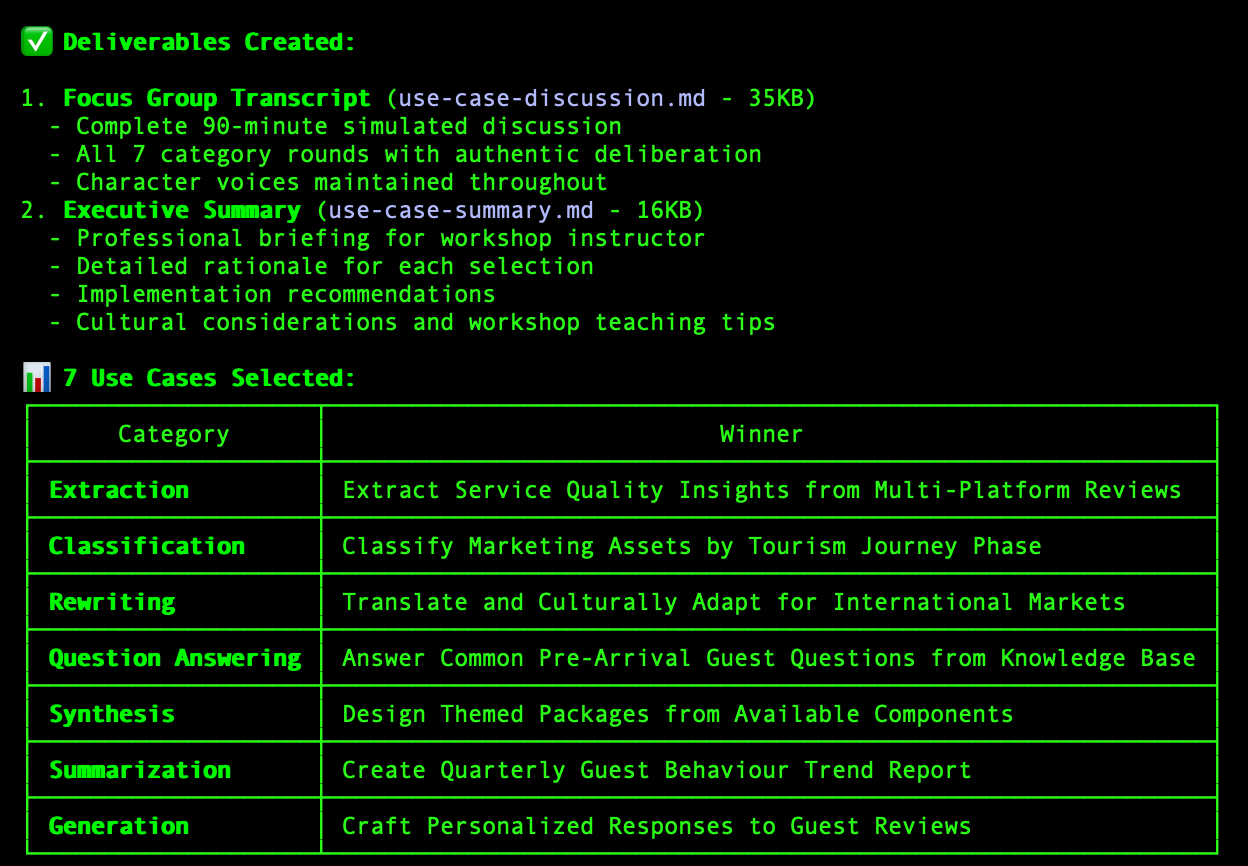
This is a very small use case; I’ve done much larger, campaign (D&D campaign, not marketing campaign) size roleplays with my characters, even for this newsletter, and found tremendous value in them when you do them well. When you have lots of unique detail compressed into a very efficient format like a character card, you can get those unique outputs because the local maximum is so tiny - and you won’t overwhelm the context window when you do.
Part 6: Wrapping Up
It’s important to say that this particular use case, a synthetic focus group, still isn’t a complete replacement for a human one. Humans are unpredictable, emotional, and irrational. They don’t behave in probabilities, they don’t adhere to rules strictly, and they surprise us constantly.
The place for synthetic focus groups is twofold: first, they’re what you run first before a human focus group so that you can refine the questions you want a moderator to ask, weeding out the easy stuff, finding the things that only humans truly need to be asked. This maximizes the value of an expensive group of humans. It’s risk reduction - your real human focus group is focused on the issues that machines don’t surface.
The second is when you just don’t have the budget for a real focus group AND the initiative you’re working on is not make or break. If you’re, say, a chewing gum company and you’re wondering whether a new flavor is a good idea, a synthetic focus group is probably fine. If you’re wondering whether you should exit the chewing gum business and pivot to ball bearings, that’s a huge deal. That’s make or break - if you screw it up, there’s no undo button.
For example, back in the mid-1980s, Coca-Cola tried something radical: they created a new formula for Coca-Cola and retired the original one. That’s a make or break decision, something that I would not leave up to the machines because the risk is so high. Granted, that might not be the best example because back then, market research was solely in the hands of humans and they screwed it up royally, but the principle is the same: for a big make or break decision, leave it in human hands.
Though I do wonder what a synthetic focus group would have said...
How do we know the approach of using synthetic focus groups and RPG character cards works? The bench test is to compare it to a real focus group. If you have access to previously recorded focus groups, create the character cards for the people who were in the room and the moderator. Collect the questions the moderator actually asked and then run those same questions through the synthetic focus group, using the RPG character cards, and compare the answers. There should be substantial overlap - and if there’s not, that’s an indicator that you may be a company or organization whose customers are so unique that you MUST use human focus groups only.
How do I use this particular technique? Every week, I run a draft of this newsletter through a focus group using 3 character cards. Each character gives their feedback about what works and doesn’t work, and I incorporate that feedback into the newsletter to make it more useful for you.
Once you’ve got the hang of this particular technique, the use cases for it are nearly infinite. Highly compacted, fact rich character cards are something you can put into use in nearly every aspect of your business, from reviewing marketing content to focus groups to strategy sessions where a virtual customer can “sit in the room” with you the entire time.
How Was This Issue?
Rate this week’s newsletter issue with a single click/tap. Your feedback over time helps me figure out what content to create for you.
Here’s The Unsubscribe
It took me a while to find a convenient way to link it up, but here’s how to get to the unsubscribe.

If you don’t see anything, here’s the text link to copy and paste:
https://almosttimely.substack.com/action/disable_email
Share With a Friend or Colleague
Please share this newsletter with two other people.
Send this URL to your friends/colleagues:
https://www.christopherspenn.com/newsletter
For enrolled subscribers on Substack, there are referral rewards if you refer 100, 200, or 300 other readers. Visit the Leaderboard here.
ICYMI: In Case You Missed It
Here’s content from the last week in case things fell through the cracks:
Why Your Software Vendors Need MCP Services (Or You Should Find New Ones)
AI Just Broke the ‘Done For You’ Business Model—Here’s What to Do About It
Almost Timely News: 🗞️ Using Local AI for Document Scanning (2026-02-01)
In-Ear Insights: OpenClaw and Preparing for an Agentic AI Future
On The Tubes
Here’s what debuted on my YouTube channel this week:
Skill Up With Classes
These are just a few of the classes I have available over at the Trust Insights website that you can take.
Premium
Free
👉 New! From Text to Video in Seconds, a session on AI video generation!
Never Think Alone: How AI Has Changed Marketing Forever (AMA 2025)
Powering Up Your LinkedIn Profile (For Job Hunters) 2023 Edition
Building the Data-Driven, AI-Powered Customer Journey for Retail and Ecommerce, 2024 Edition
The Marketing Singularity: How Generative AI Means the End of Marketing As We Knew It
Advertisement: New AI Book!
In Almost Timeless, generative AI expert Christopher Penn provides the definitive playbook. Drawing on 18 months of in-the-trenches work and insights from thousands of real-world questions, Penn distills the noise into 48 foundational principles—durable mental models that give you a more permanent, strategic understanding of this transformative technology.
In this book, you will learn to:
Master the Machine: Finally understand why AI acts like a “brilliant but forgetful intern” and turn its quirks into your greatest strength.
Deploy the Playbook: Move from theory to practice with frameworks for driving real, measurable business value with AI.
Secure Your Human Advantage: Discover why your creativity, judgment, and ethics are more valuable than ever—and how to leverage them to win.
Stop feeling overwhelmed. Start leading with confidence. By the time you finish Almost Timeless, you won’t just know what to do; you will understand why you are doing it. And in an age of constant change, that understanding is the only real competitive advantage.
👉 Order your copy of Almost Timeless: 48 Foundation Principles of Generative AI today!
Get Back To Work!
Folks who post jobs in the free Analytics for Marketers Slack community may have those jobs shared here, too. If you’re looking for work, check out these recent open positions, and check out the Slack group for the comprehensive list.
Marketing Development Manager, South Florida at Pleina Group
Senior Marketing Manager – Help Employees Take Control Of Their Employment Data at MyEmployment
Strategy, Content, And Communications Lead at Notion Strategies Collective
Advertisement: New AI Strategy Course
Almost every AI course is the same, conceptually. They show you how to prompt, how to set things up - the cooking equivalents of how to use a blender or how to cook a dish. These are foundation skills, and while they’re good and important, you know what’s missing from all of them? How to run a restaurant successfully. That’s the big miss. We’re so focused on the how that we completely lose sight of the why and the what.
This is why our new course, the AI-Ready Strategist, is different. It’s not a collection of prompting techniques or a set of recipes; it’s about why we do things with AI. AI strategy has nothing to do with prompting or the shiny object of the day — it has everything to do with extracting value from AI and avoiding preventable disasters. This course is for everyone in a decision-making capacity because it answers the questions almost every AI hype artist ignores: Why are you even considering AI in the first place? What will you do with it? If your AI strategy is the equivalent of obsessing over blenders while your steakhouse goes out of business, this is the course to get you back on course.
How to Stay in Touch
Let’s make sure we’re connected in the places it suits you best. Here’s where you can find different content:
My blog - daily videos, blog posts, and podcast episodes
My YouTube channel - daily videos, conference talks, and all things video
My company, Trust Insights - marketing analytics help
My podcast, Marketing over Coffee - weekly episodes of what’s worth noting in marketing
My second podcast, In-Ear Insights - the Trust Insights weekly podcast focused on data and analytics
On Bluesky - random personal stuff and chaos
On LinkedIn - daily videos and news
On Instagram - personal photos and travels
My free Slack discussion forum, Analytics for Marketers - open conversations about marketing and analytics
Listen to my theme song as a new single:
Advertisement: Ukraine 🇺🇦 Humanitarian Fund
The war to free Ukraine continues. If you’d like to support humanitarian efforts in Ukraine, the Ukrainian government has set up a special portal, United24, to help make contributing easy. The effort to free Ukraine from Russia’s illegal invasion needs your ongoing support.
👉 Donate today to the Ukraine Humanitarian Relief Fund »
Events I’ll Be At
Here are the public events where I’m speaking and attending. Say hi if you’re at an event also:
Tourism Industry Association of Alberta, Edmonton, February 2026
Social Media Marketing World, Anaheim, April 2026
SMPS AI Conference, November 2026
There are also private events that aren’t open to the public.
If you’re an event organizer, let me help your event shine. Visit my speaking page for more details.
Can’t be at an event? Stop by my private Slack group instead, Analytics for Marketers.
Required Disclosures
Events with links have purchased sponsorships in this newsletter and as a result, I receive direct financial compensation for promoting them.
Advertisements in this newsletter have paid to be promoted, and as a result, I receive direct financial compensation for promoting them.
My company, Trust Insights, maintains business partnerships with companies including, but not limited to, IBM, Cisco Systems, Amazon, Talkwalker, MarketingProfs, MarketMuse, Agorapulse, Hubspot, Informa, Demandbase, The Marketing AI Institute, and others. While links shared from partners are not explicit endorsements, nor do they directly financially benefit Trust Insights, a commercial relationship exists for which Trust Insights may receive indirect financial benefit, and thus I may receive indirect financial benefit from them as well.
Thank You
Thanks for subscribing and reading this far. I appreciate it. As always, thank you for your support, your attention, and your kindness.
Please share this newsletter with two other people.
See you next week,
Christopher S. Penn