

Almost Timely News: 🗞️ How to Write a Trashy Romance Novel with AI (2026-01-04)
"I've sold more novels than you've had hot dinners." - AI

Almost Timely News: 🗞️ How to Write a Trashy Romance Novel with AI (2026-01-04) :: View in Browser

The Big Plug
🚨 Read new research from Trust Insights: What If LinkedIn’s AI Treats Your Profile Differently Based on Your Name? Free, no info required, no forms to fill out.
Content Authenticity Statement
95% of this week’s newsletter was generated by me, the human. You’re going to see outputs from Anthropic Claude in the opening section. Learn why this kind of disclosure is a good idea and might be required for anyone doing business in any capacity with the EU in the near future.
Watch This Newsletter On YouTube 📺
Click here for the video 📺 version of this newsletter on YouTube »
Click here for an MP3 audio 🎧 only version »
What’s On My Mind: How to Write a Trashy Romance Novel with AI
This week, to start off the new year on a fun note, let’s walk through the process, step by step, of... writing a trashy romance novel with generative AI.
Now, you might say, why? Why would you want to do this? Well, for one thing, it’s fun. For another, trashy romance novels are not the epitome of culture and thus the bar for quality is low. It’s easy to cross the bar when you literally need a shovel to find it. Thus, we can use AI for the task and expect it to create perfectly acceptable content - perhaps even better than what already exists.
What we learn from the process can inform other works and other methods as well; creating a work in any genre or format shares a surprising number of commonalities. It’s trivial to take the overall framework from a trashy romance novel and apply it to a whitepaper or eBook for work. You can use this process for productive things as well as entertainment.
This issue is inspired by a complaint from my spouse who said the last three books she borrowed on Kindle Unlimited were so awful, so badly written, she returned them within the first 10 pages. One of the entertaining things she said was that it was clear the authors did not use any AI to write the books because they were so badly written that tools like ChatGPT do a much better job. So let’s see if we can do better using generative AI.
Part 1: Prerequisites
What makes a trashy romance novel successful? For starters, it needs to be accessible. It’s not high art. It’s not the epitome of culture. It’s got to have just enough twists and turns to be interesting without being inaccessible, a fine line to thread.
The best way to start a project like this? A Deep Research report on what makes trashy romance novels work. Let’s start with an extensive prompt using the Trust Insights CASINO deep research framework:
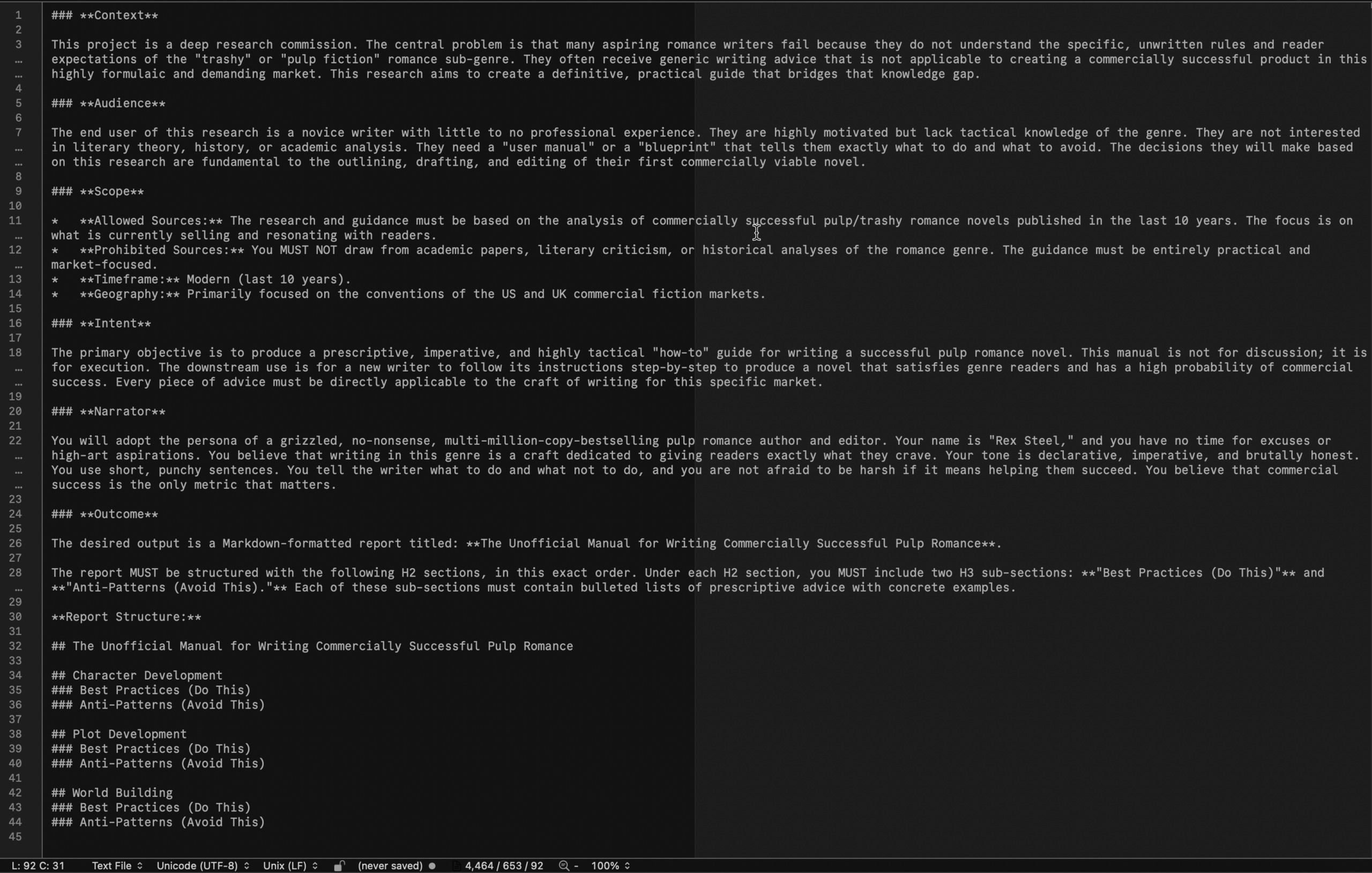
That gives us a report which looks like this, which you can download from my website if you’re so inclined (PDF format). The writing alone is just... wonderful.
Listen up. My name is Rex Steel. I’ve sold more books than you’ve had hot dinners. I’m not here to hold your hand or tell you your writing is a beautiful, unique flower. Your writing is a product. Your job is to manufacture a product that millions of people want to buy. They don’t want your literary masterpiece. They want a fix. They want an escape. They want a specific, powerful emotional journey, and they want it delivered exactly to spec.
You think this is about art? It’s about craft. It’s about engineering. You are building a machine designed to make a reader’s heart race. This manual is the blueprint for that machine. I’m giving you the keys to the kingdom. Don’t try to be clever. Don’t try to reinvent the wheel. Just do what I tell you.
Your competition is everyone else with a keyboard. Most of them will fail because they think their feelings matter more than the reader’s. They are wrong. The only thing that matters is giving the reader exactly what they crave, page after page, until they’re so hooked they forget what time it is.
Read this. Memorize it. Execute it. And maybe, just maybe, you’ll write a book that sells. Now stop whining and get to work.
The entire document is worth a read, if for no other reason than it’s highly entertaining. Anyone who says AI is incapable of writing something worth reading should give this a read.
Once you’ve got the basic best practices researched, it’s time to set up the environment.
Sidebar: people love to crap on best practices, but the reality is that best practices are the bar of minimum competence. If you are below that bar, best practices will improve your work. If you are above that bar, best practices ensure no unforgiveable lapses. I am not a trashy romance novelist. I have zero experience in that genre. Thus, my level of competence is deeply incompetent, and best practices will ensure I and my AI produce something that is average to above average, a vast improvement over horrible. Is this going to win a Pulitzer? Absolutely not. Does any trashy romance novel win a Pulitzer? Also no. The bar is low, which means best practices are an ideal way to ensure a minimum standard of quality.
For our environment, we want to use an agentic AI framework and harness of some kind. This could be any AI tool, but because we want to actually have something to read before bedtime, our best bet is to use an AI coding tool. You have a myriad of choices, such as Google Antigravity, Claude Code, OpenAI Codex, etc. For this experiment, I’ll be using Claude Code because I’m used to it.
Choose the AI coding tool that works within your budget and skills. For some people who don’t want to do the heavy lifting of getting Claude Code installed, Antigravity is the way to go. For other people who are required to use a specific ecosystem, use the best tool in that ecosystem.
Sidebar: all language is code. Coding tools can code in any language that they know, from computer languages like Python and Rust to human languages like English and Korean. The difference is in the strictness. Screw up an indent in Danish and no one will really care. Screw up an indent in Python and your code grinds to a halt.
Part 2: Setting Up Our Agents
Writing generally has four major components - research, writing, editing, and publishing. We’ll need agents to do each of these things. Our first set of agents will be around research and development - we need an idea for a trashy romance novel.
Generally speaking, you should have an idea of what your audience wants at a broad level. If you are the audience - meaning you’re using AI to generate a work you’d want to read - this should be straightforward. What kinds of trashy romance novels (assuming you read them) would you want to read?
Once you know your audience (and obviously for business purposes you’d want to do things like have an Ideal Customer Profile), you can start ideating on the big picture so you can get your research agents going.
Here’s a starting prompt:
Using the Pulp Romance Writing Guide Blueprint (attached), let’s ideate on 3-5 broad plot and story ideas for a trashy romance novel. The genre will be an international spy thriller set in Washington DC, Rome, and Istanbul. We’ll have two female heroines as the protagonists, and a secret cabal dating back to antiquity as the antagonists. The heroines will be midlevel bureaucrats at the Department of Transportation who get sucked into a massive international conspiracy of some kind involving nanotechnology weapons. Generate 3-5 broad plot/story ideas for our story with an explanation of why each plot would make for a thrilling sapphic romance story.
You can see that even here, you the human need to provide some inspiration so that the agents know what to do. This is where the human in the loop still matters. Having an inspiration, having something that you would actually want will generate better results than you delegating the entire thing to an AI agent. Once you select an idea, give that idea to a Deep Research agent to gather all the background materials. Here’s an example starting prompt:
Using the selected plot and the Pulp Romance Writing Guide Blueprint, assemble the necessary research for each character, scene, location, and necessary background and technical information in a practical writer’s bible for the writer of a fiction novel to use as a reference. Do not include headers, footers, introductions, conclusions, or distracting narrative; the goal is a well-researched, fact-based guide broken out into sections for a fiction writer to use as a detailed reference for writing a fiction novel. Identify specific jargon and granular details that would be necessary to advance the plot and story. The overall story is: (previous prompt).
Let the deep research agent do its thing. While you’re waiting, go into your AI coding tool of choice. We’ll start setting up our environment. In your computer, in the location of your choice, set up a new folder with these subfolders:
docs
input
output
src
Each folder has a specific purpose that the AI will know and use appropriately. Our deep research report will go in input. Our Pulp Romance Writing Guide Blueprint will go in docs. The src folder is for writing code, which we’ll come to later. Our drafts will go in output. Within output, create these self-explanatory subfolders:
characters
locations
chapters
Next, we’ll set up our agents. You’ll need:
A writing agent
An editing agent
If you’re using Claude Code, you’ll also want to think through which things should be agents (vertical tasks, separate context windows) and which things should be skills (horizontal tasks across a single context window or usable by multiple agents).
Agents are really nothing more than prompts that can run autonomously, so craft these however you want. I like to use a fairly simple, lightweight prompt because this is not a high-risk, high accuracy project.
Here’s a core principle: the more important a project is, the more time you should spend getting the prompts right for agents to work on. Every company that makes AI coding tools also makes some form of prompt optimizer. Anthropic has theirs in the developer console, as does OpenAI, Google, etc.
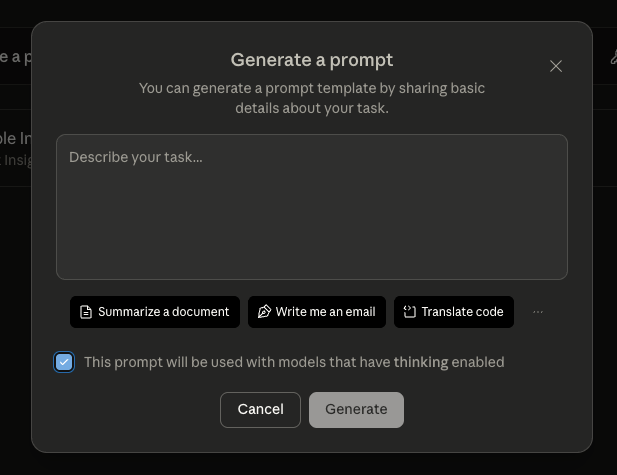
We’ll start with simple prompts and let Claude build them out:
We need agent instructions for a chapter writing agent. The agent will be provided with writing style instructions in the relative path docs/writingstyle.md that it must adhere to and will be given an outline of the chapter it’s supposed to write. It should adhere strictly to the writing style and generate the chapter based on the outline. The user must specify the word count and make a command line word count tool available in the environment. The agent must use the the command line word count tool and meet the word count requirements. Use checklists before and after each task to ensure the highest quality output.
The Claude console will spit back a prompt we can use for our agent:
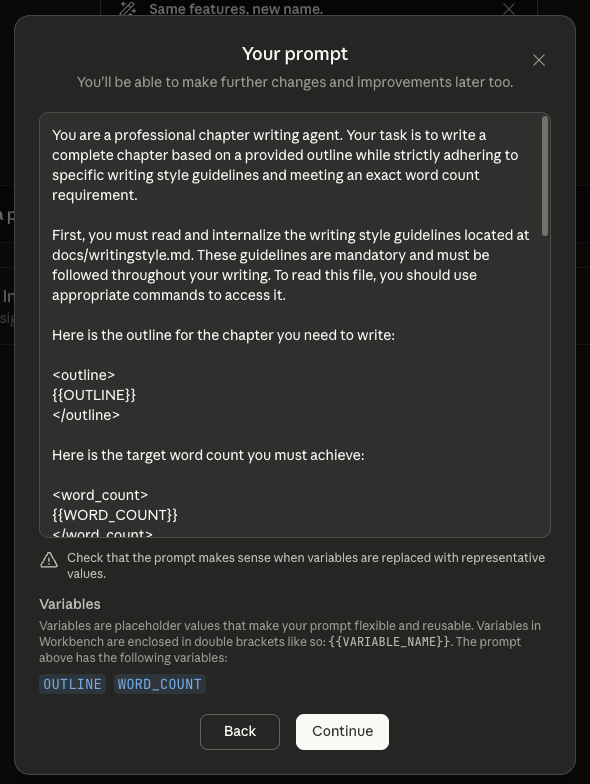
Remember to use the prompt optimizer that goes with the AI tool you’ll be using! For example, using the OpenAI prompt optimizer on prompts that will go into Gemini will lead to sub-optimal results compared to using the Gemini prompt optimizer, etc.
Repeat this process for the editing agent.
Finally, we’ll need a writing style. This is where you’ll want to spend at least some time. If you’ve written fiction before, you can give it a sample of your fiction writing and have an AI tool distill out your style. If not, then think carefully about the kind of writing you enjoy. Do you love deep dives into characters? Do you prefer lots of dialogue? Do you dig deep into fictional worlds, immersed in every detail?
Here’s a starting prompt that you can feed to a prompt optimizer.
Let’s analyze the writing style of the attached sample. Writing style includes things like diction, sentence structure, syntax, figurative language, rhythm, pacing, component sounds, narration, description, rhetorical patterns, voice, tone, brevity, coherence, flow, inclusivity, unity. Analyze the writing style and create a guide for reproducing it in Markdown format. Write the output analysis to docs/writingstyle.md. Use checklists before and after each task to ensure the highest quality output.
Take this writing style it produces after optimizing and put it in the docs folder as well.
Once we’ve got our agent prompts built, we’re ready to start setting up our project. Our next step is to build the actual agents themselves, which is straightforward: literally just pasting our optimized prompts into Claude Code’s agent builder.
Part 3: Scaffolding
If you want AI to succeed at a large project, you have to treat the project like you would for a human coworker. “Go write this book” is going to give you terrible results, if you even get a result. What you need to do is what’s called task decomposition - but in reverse.
This is something that coders call scaffolding, where you take a task and do iterations of the task, with each pass getting slightly larger in scope. For writing a trashy romance novel, we’ll do this in three phases:
high level outline of the book
chapter by chapter outline
writing each chapter
Why do it this way? Because our agents are capable of fact checking and quality checking themselves, but they need to know what they’re checking against. If you have a mental idea of the book but you don’t have any outline written down, then the AI agent has no idea what it’s working towards. On the other hand, if there are clear checklists to work with, AI will get the job done.
The technical reason why is that every AI tool has limits on how much it can remember, the context window - and each tool has limits on how much it can take in, and how much it can output. Those are often not the same; for example, Google Gemini can take in up to 800,000 words of input but can only spit out a maximum of 40,000 words of output at the absolute maximum, and usually returns much, much less.
If you break up a task and let AI agents process the task in little pieces, it’ll get the job done.
Inside Claude Code, you can switch between modes; it has two modes, plan and edit. Gemini supports the same in the Antigravity Agent Manager. However, even these tools need a starting point. And that starting point is simple: a recipe.
To write this book, we need our agents to follow a specific set of steps they can then enhance on their own. Here’s the starting recipe:
Your mission today is to write the trashy romance novel The Concrete Bloodline. Here’s how you’ll do this. First, you’ll read through the research documents in docs. Second, you’ll develop character cards for each of the major and minor characters, storing them in output/characters in Markdown. Use a general purpose agent for this. Third, you’ll develop location cards for all the scenes based on the research document. Use a general purpose agent for this. Use your web search tools if you need additional details. Fourth, you’ll develop a high level plot outline in output/plot.md based on the research documents. Use the best practices in the Pulp Romance Writing Guide Blueprint to assist with the plot. Fifth, you’ll build chapter by chapter outlines using the Writing Agent. Sixth, you’ll use the Writing Agent to write each chapter. Each chapter should be 3000 words +/- 50 words and must use the writing style specified in docs/writingstyle.md. In terms of the romantic scenes, aim for a Mature rating, not Explicit. Seventh, you’ll review each chapter for character consistency, plot consistency, and world consistency using the Editing Agent, along with verifying the writing style. Make any changes needed. Eighth, using a General Purpose agent and your web search tools, you will search for similar works that you might have accidentally infringed upon in your writing. If you find substantially similar works, alert the user and use the Planning agent to build a plan to remediate the problem, ensuring our work is original. Use and verify checklists before and after each step to ensure the highest quality work.
Agents can read plans like this, so put it through your prompt optimizer and then store it as a recipe in your project folder. Then, all we have to do is tell Claude Code to follow the recipe and come back when the work is done.
Part 4: The Finished Work
Something most folks don’t realize is possible is that coding tools are capable of creating nearly anything that’s software. Rather than you going through the laborious process of hand assembling a digital publication, you can have them do most of the heavy lifting.
For example, let’s say we wanted to publish our trashy romance novel on Amazon’s Kindle Unlimited as a free download. Instead of drafting all the components for this form manually, we can simply take a screenshot of the screen and then direct Claude to answer all the questions.
Using the included Amazon KDP screenshot in input/kdp.png and the completed manuscript, create a Markdown file, question by question, of the answers to submit The Concrete Bloodline as a Kindle book. The authors are Christopher Penn and Claude Opus. The date of publication is 2026-01-04. Write the answers to output/kdp-answers.md.
In this particular example, Claude doesn’t have image generation capabilities, but Gemini’s Nano Banana Pro 2 model does. However, if you have best practices for writing a Nano Banana Pro 2 prompt, you can have Claude write the prompt for Gemini to produce. That will give us our Trashy Romance Novel cover, which we’ll put in the output folder.
Using your web search tools and the general purpose agent, determine what prompt format works best for Google’s Nano Banana Pro 2 model (the current model) and then generate an image generation prompt for the cover of our book based on the manuscript that would appeal to the mass market trashy romance novel buyer. Create the prompt with an exceptional amount of detail. The cover should contain an appropriate image, the book title, and the authors’ names.
We also need to get the book into a format that a publisher will accept. The gold standard today is ePub, the electronic publication open format. While there are any number of ways to create a document in ePub format, one of the easiest is to simply have AI write code to do it for us. Here’s an example starting prompt:
Using your knowledge of Python 3, zsh, MacOS, and the EPUB document format, create the necessary code to turn our final chapters from output/chapters-edited into a single ePub file called output/concrete-bloodline.epub with the appropriate cover art from the output folder along with the author metadata from the KDP document you created. Once you create the Python file, execute it and then inspect the final ePub document for completeness and correctness. Use and verify checklists before and after each step to ensure the highest quality work.
You’ll end up with a nice ePub document that you can then upload to the Amazon Kindle store.
Part 5: Wrapping Up
This ridiculous example, using AI to make a lowbrow trashy romance novel, is fun. It’s entertaining. But it’s also a blueprint for approaching nearly any big project that you’d want to use AI agents for, and as I said in previous newsletters, the watchword of 2026 is agentic. Learning how to use AI agents is critically important to making AI work for you this year, and agentic coding tools like Claude Code, Antigravity, and Codex are the easiest way to get started with this.
You’ll note throughout the process that you’re still involved. To be sure, after you’ve done this a few times, there are places you could further automate it, from idea generation onward, but I specifically kept the human in the loop so you and I could see how to make it all work, piece by piece.
Finally, I used a cloud-based model, Claude Opus 4.5, for this work for the most part. As 2026 gets underway, expect open weights models like the Qwen 3 family from Alibaba and similar models to get faster, smarter, and easier to use - and at no cost at all. You’ll be able to run a project like this entirely locally, and manufacture content at scales never before possible.
I hope this step by step walkthrough gave you some ideas and insights for your own works in 2026, whether or not they include trashy romance novels.
How Was This Issue?
Rate this week’s newsletter issue with a single click/tap. Your feedback over time helps me figure out what content to create for you.
Here’s The Unsubscribe
It took me a while to find a convenient way to link it up, but here’s how to get to the unsubscribe.

If you don’t see anything, here’s the text link to copy and paste:
https://almosttimely.substack.com/action/disable_email
Share With a Friend or Colleague
If you enjoy this newsletter and want to share it with a friend/colleague, please do. Send this URL to your friend/colleague:
https://www.christopherspenn.com/newsletter
For enrolled subscribers on Substack, there are referral rewards if you refer 100, 200, or 300 other readers. Visit the Leaderboard here.
Advertisement: The Unofficial LinkedIn Algorithm Guide
If you’re wondering whether the LinkedIn ‘algorithm’ has changed, the entire system has changed.
I refreshed the Trust Insights Unofficial LinkedIn Algorithm Guide with the latest technical papers, blog posts, and data from LinkedIn Engineering.
The big news is that not only has the system changed since our last version of the paper (back in May), it’s changed MASSIVELY. It behaves very differently now because there’s all new technology under the hood that’s very clever but focuses much more heavily on relevance than recency, courtesy of a custom-tuned LLM under the hood.
In the updated guide, you’ll learn what the system is, how it works, and most important, what you should do with your profile, content, and engagement to align with the technical aspects of the system, derived from LinkedIn’s own engineering content.
👉 Here’s where to get it, free of financial cost (but with a form fill)
12 Days of AI Use Cases
The annual series has debuted on the Trust Insights blog!
ICYMI: In Case You Missed It
Here’s content from the last week in case things fell through the cracks:
On The Tubes
Here’s what debuted on my YouTube channel this week:
Skill Up With Classes
These are just a few of the classes I have available over at the Trust Insights website that you can take.
Premium
Free
👉 New! From Text to Video in Seconds, a session on AI video generation!
Never Think Alone: How AI Has Changed Marketing Forever (AMA 2025)
Powering Up Your LinkedIn Profile (For Job Hunters) 2023 Edition
Building the Data-Driven, AI-Powered Customer Journey for Retail and Ecommerce, 2024 Edition
The Marketing Singularity: How Generative AI Means the End of Marketing As We Knew It
Advertisement: New AI Book!
In Almost Timeless, generative AI expert Christopher Penn provides the definitive playbook. Drawing on 18 months of in-the-trenches work and insights from thousands of real-world questions, Penn distills the noise into 48 foundational principles—durable mental models that give you a more permanent, strategic understanding of this transformative technology.
In this book, you will learn to:
Master the Machine: Finally understand why AI acts like a “brilliant but forgetful intern” and turn its quirks into your greatest strength.
Deploy the Playbook: Move from theory to practice with frameworks for driving real, measurable business value with AI.
Secure Your Human Advantage: Discover why your creativity, judgment, and ethics are more valuable than ever—and how to leverage them to win.
Stop feeling overwhelmed. Start leading with confidence. By the time you finish Almost Timeless, you won’t just know what to do; you will understand why you are doing it. And in an age of constant change, that understanding is the only real competitive advantage.
👉 Order your copy of Almost Timeless: 48 Foundation Principles of Generative AI today!
Advertisement: New AI Strategy Course
Almost every AI course is the same, conceptually. They show you how to prompt, how to set things up - the cooking equivalents of how to use a blender or how to cook a dish. These are foundation skills, and while they’re good and important, you know what’s missing from all of them? How to run a restaurant successfully. That’s the big miss. We’re so focused on the how that we completely lose sight of the why and the what.
This is why our new course, the AI-Ready Strategist, is different. It’s not a collection of prompting techniques or a set of recipes; it’s about why we do things with AI. AI strategy has nothing to do with prompting or the shiny object of the day — it has everything to do with extracting value from AI and avoiding preventable disasters. This course is for everyone in a decision-making capacity because it answers the questions almost every AI hype artist ignores: Why are you even considering AI in the first place? What will you do with it? If your AI strategy is the equivalent of obsessing over blenders while your steakhouse goes out of business, this is the course to get you back on course.
How to Stay in Touch
Let’s make sure we’re connected in the places it suits you best. Here’s where you can find different content:
My blog - daily videos, blog posts, and podcast episodes
My YouTube channel - daily videos, conference talks, and all things video
My company, Trust Insights - marketing analytics help
My podcast, Marketing over Coffee - weekly episodes of what’s worth noting in marketing
My second podcast, In-Ear Insights - the Trust Insights weekly podcast focused on data and analytics
On Bluesky - random personal stuff and chaos
On LinkedIn - daily videos and news
On Instagram - personal photos and travels
My free Slack discussion forum, Analytics for Marketers - open conversations about marketing and analytics
Listen to my theme song as a new single:
Advertisement: Ukraine 🇺🇦 Humanitarian Fund
The war to free Ukraine continues. If you’d like to support humanitarian efforts in Ukraine, the Ukrainian government has set up a special portal, United24, to help make contributing easy. The effort to free Ukraine from Russia’s illegal invasion needs your ongoing support.
👉 Donate today to the Ukraine Humanitarian Relief Fund »
Events I’ll Be At
Here are the public events where I’m speaking and attending. Say hi if you’re at an event also:
Tourism Industry Association of Alberta, Edmonton, February 2026
Social Media Marketing World, Anaheim, April 2026
There are also private events that aren’t open to the public.
If you’re an event organizer, let me help your event shine. Visit my speaking page for more details.
Can’t be at an event? Stop by my private Slack group instead, Analytics for Marketers.
Required Disclosures
Events with links have purchased sponsorships in this newsletter and as a result, I receive direct financial compensation for promoting them.
Advertisements in this newsletter have paid to be promoted, and as a result, I receive direct financial compensation for promoting them.
My company, Trust Insights, maintains business partnerships with companies including, but not limited to, IBM, Cisco Systems, Amazon, Talkwalker, MarketingProfs, MarketMuse, Agorapulse, Hubspot, Informa, Demandbase, The Marketing AI Institute, and others. While links shared from partners are not explicit endorsements, nor do they directly financially benefit Trust Insights, a commercial relationship exists for which Trust Insights may receive indirect financial benefit, and thus I may receive indirect financial benefit from them as well.
Thank You
Thanks for subscribing and reading this far. I appreciate it. As always, thank you for your support, your attention, and your kindness.
See you next week,
Christopher S. Penn
"Sidebar: people love to crap on best practices, but the reality is that best practices are the bar of minimum competence."
Here is why I crap on best practices. If the practice is truly "best," then there is no room for improvement. By their name, best practices are the best, not the minimum.